
Most ministries track what donors give. Far fewer track what drives giving. Yet one finding keeps surfacing in research from Grey Matter Research and Infinity Concepts: ahead of age, income, and race, the strongest predictor of whether evangelicals give, how generously they give, and whether they serve is how spiritually engaged they are.
Habakkuk 2:2 calls us to “write the vision and make it plain.” Good measurement does the same for a donor file: it makes plain what is actually happening.
What the score measures
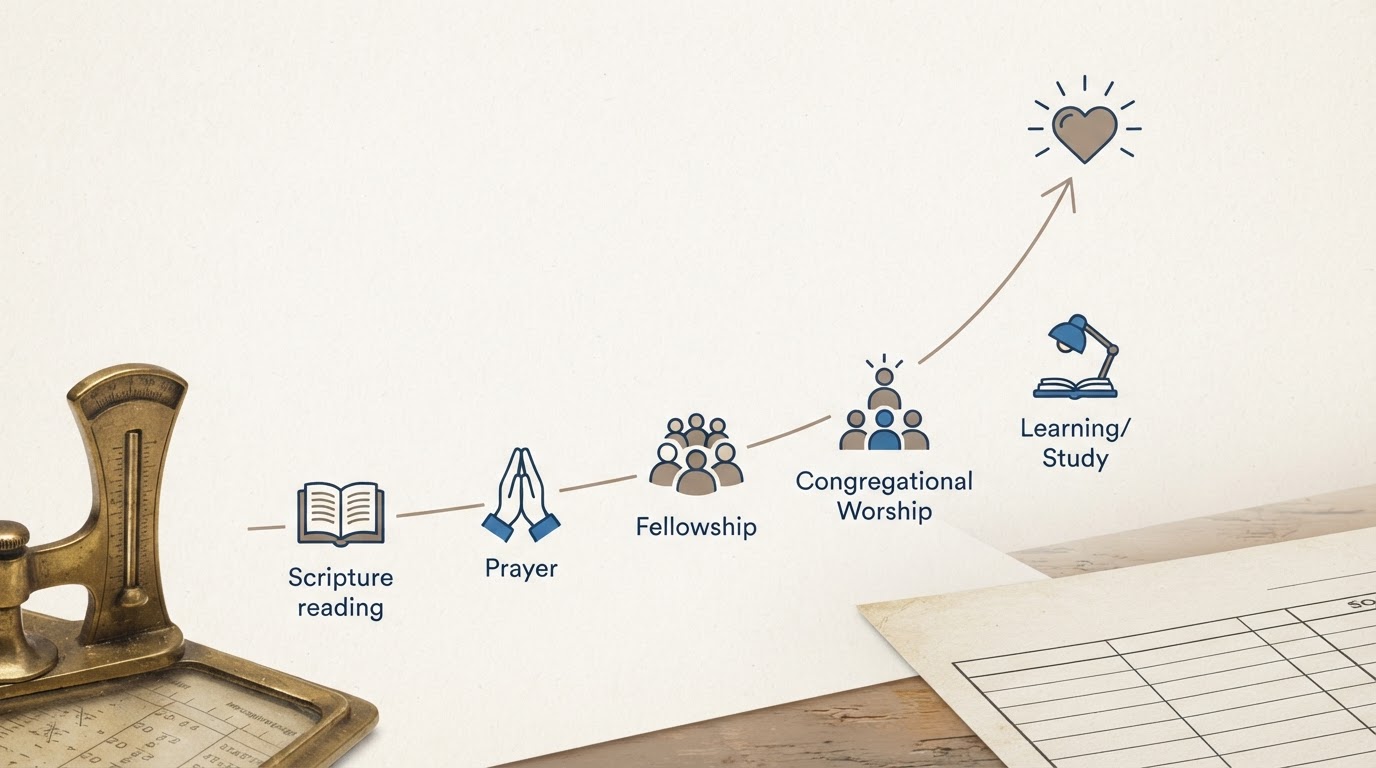
Following its 2021 generosity study, Grey Matter Research developed the Spiritual Engagement Score (SES), a measure of how often a person practices five basic spiritual disciplines. Each is worth up to 5 points, for a total of 25. Less frequent participation earns fewer points, and none earns zero. Full engagement means, at a minimum:
- Attending (or viewing) worship services every week
- Attending a small group for Bible study or prayer every week
- Praying daily and reading the Bible daily
- Studying the Bible at least a few times a week
People are grouped as Full, High, Moderate, or Low/None; so few are at None that the bottom two levels are combined. The researchers acknowledge no model like this is perfect, and it does not claim to measure the heart. It measures habits, which can actually be observed.
The Spiritual Engagement Breakdown
Grey Matter Research & Infinity Concepts · The Generosity Landscape (n=1,008)
Volunteered in past 12 months
Share of household income given
The cascade: engagement, giving, and serving
In the 2025 survey behind The Generosity Landscape (1,008 evangelical Protestants), spiritual engagement was by far the biggest predictor of both giving and generosity. Compared with someone at Low/None engagement, a fully engaged evangelical is:
Church Giving
More likely to give to their local church, and 73% more likely to give to charities outside the church.
Generosity Ratio
4.11% of household income given compared to just 0.49% for those at low engagement.
Volunteer Rate
Far more likely to volunteer; 77% of fully engaged volunteers serve monthly or more.
Likelihood to Tithe
Seven times more likely to tithe (8%+), yet even among the fully engaged only 21% tithe.
Time and money also travel together. Some 98% of evangelical volunteers also give money in some form, so “I give my time instead” is the exception, not the rule.
Perception is not practice
The 2026 Spiritual Report Card shows why an observable measure matters. Asked to grade themselves on “putting God first,” 15% of evangelicals who gave themselves an A had Low/None engagement, and another 32% were only Moderately engaged. Self-assessment is a poor stand-in for habits; the SES gives leaders something they can actually track.
What this means for ministry leaders
- Look beyond gift history. Understand how engaged your donors and members are, not only what they gave.
- Invest in engagement touchpoints. Bible reading plans, small groups, and prayer resources are not a detour from generosity; they lead to it.
- Treat volunteers as partners. They are already your most likely givers.
- Teach toward the tithe with realism. Even the most engaged rarely reach it; spiritual growth is a journey.
Read the full research.
Download The Generosity Landscape: How Evangelicals Give free from Infinity Concepts and Grey Matter Research at infinityconcepts.com/the-generosity-landscape.
Sources: Grey Matter Research & Infinity Concepts, The Generosity Landscape (2026; data mid-2025, n=1,008); The Giving Gap (2024; n=1,039); The Spiritual Report Card (2026; data mid-2025, n=1,008). All figures refer to U.S. evangelical Protestants.