
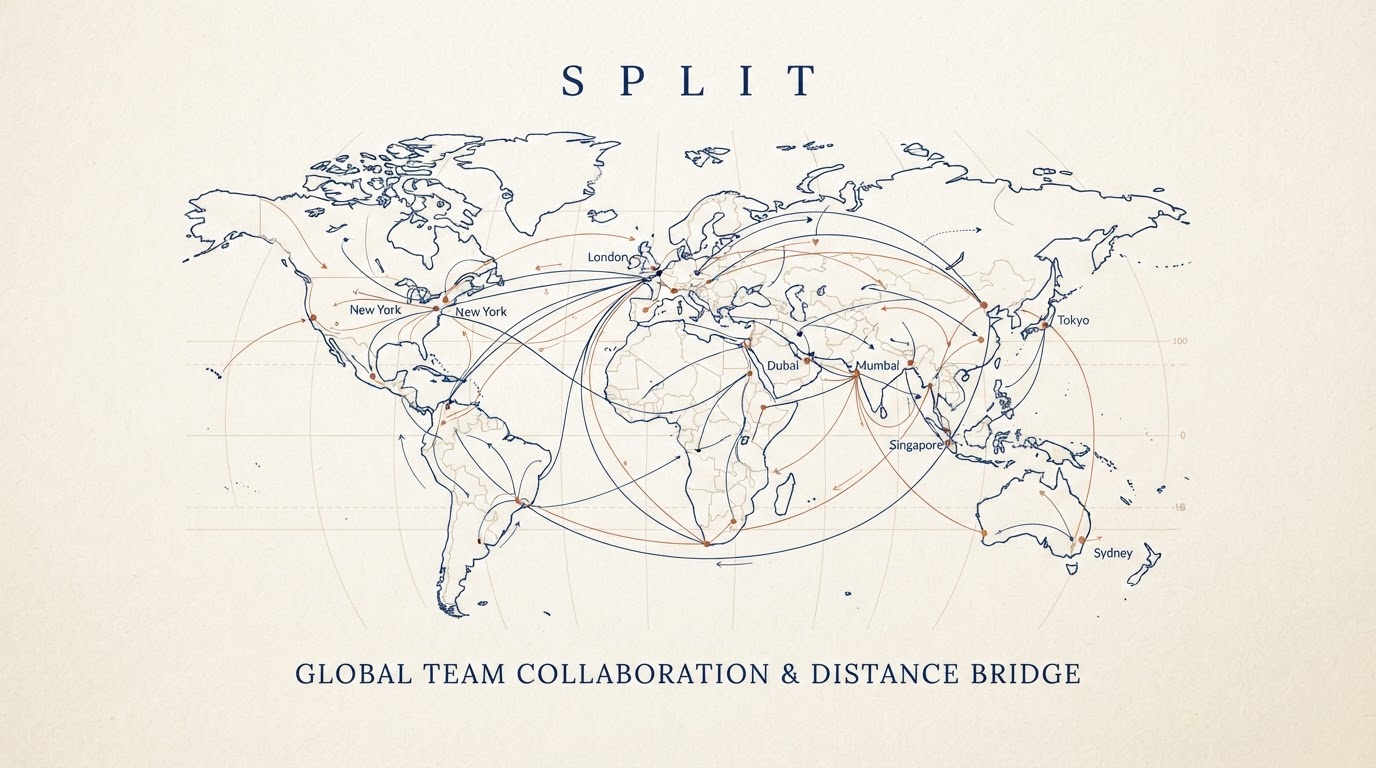
Many ministries are global by calling: field offices, missionaries, translation partners and teams that meet across continents and time zones. For many years I led international offices and worked between them and a U.S. headquarters. What I learned is that the hardest distance to close is not measured in miles. It is measured in connection.
Harvard Business School professor Tsedal Neeley has a name for it: social distance, “the degree of emotional connection among team members.” When people share an office, it stays low. When they are scattered, misunderstanding and mistrust grow easily. In her Harvard Business Review article “Global Teams That Work”, she argues that reducing it “becomes the primary management challenge for the global team leader.”
Her example is a global marketing team at a U.S. pharmaceutical company: a leader and core group near Boston headquarters, a smaller group in London, one person in Moscow and three people split between Singapore and Tokyo. Each location saw the team differently. Boston felt it did “the important work” and had easy access to the boss. The lone member in Moscow felt “at the mercy of the Boston group.” Same team, four different realities.
Neeley's SPLIT framework names five sources of social distance, and five levers a leader can pull.
Does every location feel equally valued?
Do we make deliberate time to connect?
Can everyone be heard and understood?
Do we ask before we assume?
Are our tools closing the gap or widening it?
SPLIT framework: Tsedal Neeley, “Global Teams That Work,” Harvard Business Review, October 2015. Questions are the author's.
SStructure: the perception of power
When most of a team sits in one place, and especially when the leader sits there too, the larger group can feel the others contribute less, while smaller sites feel unheard. Neeley's own illustration is a team based mostly in Germany with a few members in the United States and South Africa. Her remedy is for the leader to keep three messages in front of the team: who we are (one team, despite our differences), what we do (a shared purpose), and I am there for you (frequent contact with those farthest away).
From my experience: “I am there for you” is also communicated by how leaders treat other people's time. If a call must be cancelled, give at least 24 hours' notice. I have had to raise this more than once with U.S.-based executives who cancelled two or three hours beforehand; it reflects poorly on the leader and erodes the value of the calls. And come prepared. Their time is precious too.
PProcess: building in empathy
Dispersed teams lose the informal moments that build understanding, so Neeley urges leaders to create “deliberate moments”: feedback on routine habits, a few minutes of unstructured conversation before business begins, and time to disagree, inviting views first from those with the least status. One of her examples is a French team that answered email only first thing each morning, unaware it added an overnight delay for American colleagues and was fuelling mistrust.
From my experience: Allow time for pleasantries and catching up, even if you cover less; it builds unity and alignment. Be purposeful: send an agenda well ahead of time. Be sensitive to time zones. A U.S. midday call is often someone else's late evening or early morning, so rotate the time slot or choose a time that falls in most participants' working day. And some cultures run late; allow for it.
LLanguage: the fluency gap
The most fluent speakers of a team's common language tend to exert the most influence, while less fluent members withdraw. Neeley proposes three rules: fluent speakers dial down dominance by slowing down, avoiding idioms and confirming they were understood; less fluent speakers dial up engagement by contributing and saying when they don't understand; and leaders balance participation by drawing in quieter voices. She also cautions against letting members speak their own language while a teammate translates, because it can alienate others. One leader in Dubai posted the rules in every cubicle, and a team member spoke up in discussion for the first time in 17 months.
From my experience: Fluent is not the same as understood. Many colleagues who express themselves well in English are still translating what they hear back into their first language. Take it slow, repeat key points and ask people to restate what they understood; the real test comes when they need to act on it. Live interpretation by another person does not work well on team calls, but technology is helping. Skype was an early pioneer of translated captions, and Microsoft Teams has offered live translated captions since 2022.
IIdentity: ask before you assume
The same behavior can mean different things in different cultures. Neeley notes that in America, “Yes, I can do this” likely means willing and able, while in India it may simply signal a wish to try. Her answer is a team where “everyone is a teacher and a learner,” and where leaders ask questions before drawing conclusions.
From my experience: Work culture is part of identity. Most countries do not share the American “always on” culture. In France, for example, companies with 50 or more employees have been required since 2017 to set a “right to disconnect” policy limiting after-hours contact. What feels like responsiveness in one culture can feel like intrusion in another.
TTechnology: choose the channel on purpose
Tools can shrink social distance or widen it. Neeley offers three questions: Should communication be instant? Real-time calls persuade; email shares information with less disruption. Do I need to reinforce the message? Important points deserve more than one channel. Am I leading by example? Teams adopt the leader's habits. She adds that if a team has a history of conflict, “technology choices that limit the opportunities for real-time emotional exchanges may yield the best results.”
From my experience: Always record calls, and follow up with the key points and action items. It closes gaps, and it gives everyone a record to follow up on.
How the levers connect
The five elements work together. In Neeley's words, “Decisions about structure create opportunities for good process, which can mitigate difficulties caused by language differences and identity issues.” Technology, used strategically, supports all of them. That makes SPLIT a useful check-up: review your team against the five questions above, then adjust.
How I can help
Leading across cultures, languages and time zones was a large part of my work for more than two decades. If your ministry has teams in more than one location, I can help you assess where social distance is building, through an Organizational Assessment, and coach leaders who carry that weight.
Is distance slowing your team down? Book a discovery call at mcclintock-consulting.net/contact. To go deeper, read Neeley's full article, “Global Teams That Work,” at HBR.org.
Sources: Tsedal Neeley, “Global Teams That Work,” Harvard Business Review, October 2015 (all quotations and examples attributed to Neeley are from this article); Microsoft Translator blog, October 2022 (Teams live translated captions); Microsoft retired Skype in May 2025; France's right-to-disconnect provision took effect January 1, 2017. “From my experience” notes are the author's own.